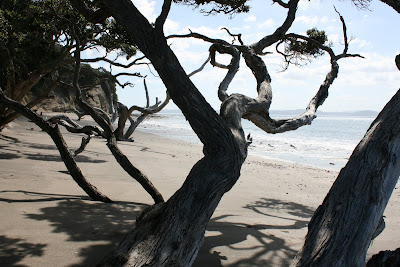
Whangaparoa

Army Bay
The creation of the world
Io-the-parentless, who created all things, stirred in the Great Nothingness. In the eye of his mind he saw the universe as it would be, one source with infinite faces. From a single blade of grass to the tallest tree, a droplet of water to a bottomless sea, all things would be kin. In their kinship would be unique and the uniqueness would each hold endless potential, just as a tiny seed becomes a tree.
Io-the-source anchored himself. The dormandt seed of the universe was born and within its core lay the germ of all things. This was the time of Te Kore, the Boundless Potential where all things could be.

The Great Nothingness turned into night. It was a night of birthing, wher the vision of Io-who-sees-all could take form just as an embryo develops in the womb. The force of opposites was born.
Fire and water came to life. Earth and air were produced.
Ranginui the male, virile and active, was born. Papatūānuku the female, fertile and passive, came into being. 'Turn and face me', they whispered. 'Let me embrace all that you are.' They joined without condition in the embrace of lovers.
 Clélia, reading under a tree in Shakespear Park
This was the time of Te Po, the Great Nights of coming into being.
Ranginui and Papatūānuku had seventy-seven sons. Seven of them emerged as leaders.
There was Tane, the catalyst, whose deeds would create the world. He would produce people, the trees of the forest and the birds of land and sea.
There was Tangaroa, who would lord over the ocean and waterways.
There was Tawhirimatea, the master of the winds and the elements.
Haumiatiketike would rule over the foods of nature.
Gentle Turongo would govern the cultivation of man.
Red faced Tūmatauenga would represent the indomitable fighting spirit of mankind.
Finally Whiro, the eldest of the seven, would become the balance keeper. He would attest all decisions and actions.
Legends of Aotearoa, by Chris Winitana

Ma Aroha a Roimata, ka heke
Ma Roimata taku ngakau, ka ea.
My love shall be the wellspring of my tears.
My tears shall clear my heart.
 Art-déco, modern design
I will try here to explain shortly how I do understand the society in New Zealand, which is so different than my Catalan culture. This is the youngest country in the world, that is, inhabitated. The maori just arrived 1.000 years ago in 7 boats and discovered these two islands in the South Pacific. They called this region "Aotearoa", which means the "land of the great white clouds".

Kia aho matuahia te taketake
Kia Tuwaerea te tau.
When intuition replaces intellect,
knowlege turns to wisdom

These two islands were much wilder than the places they previously lived. The sea was stormier, the cliffs sharper, the climate very changeable and the vegetation more dense. The vulcanos erupted and the Mother Earth showed signs of being restless everywhere they went: Tane Mahuta, the god of the trees, Ranginui, of the skies and Papatanuaku, were the most significtive and Mother Earth won importance along the years.
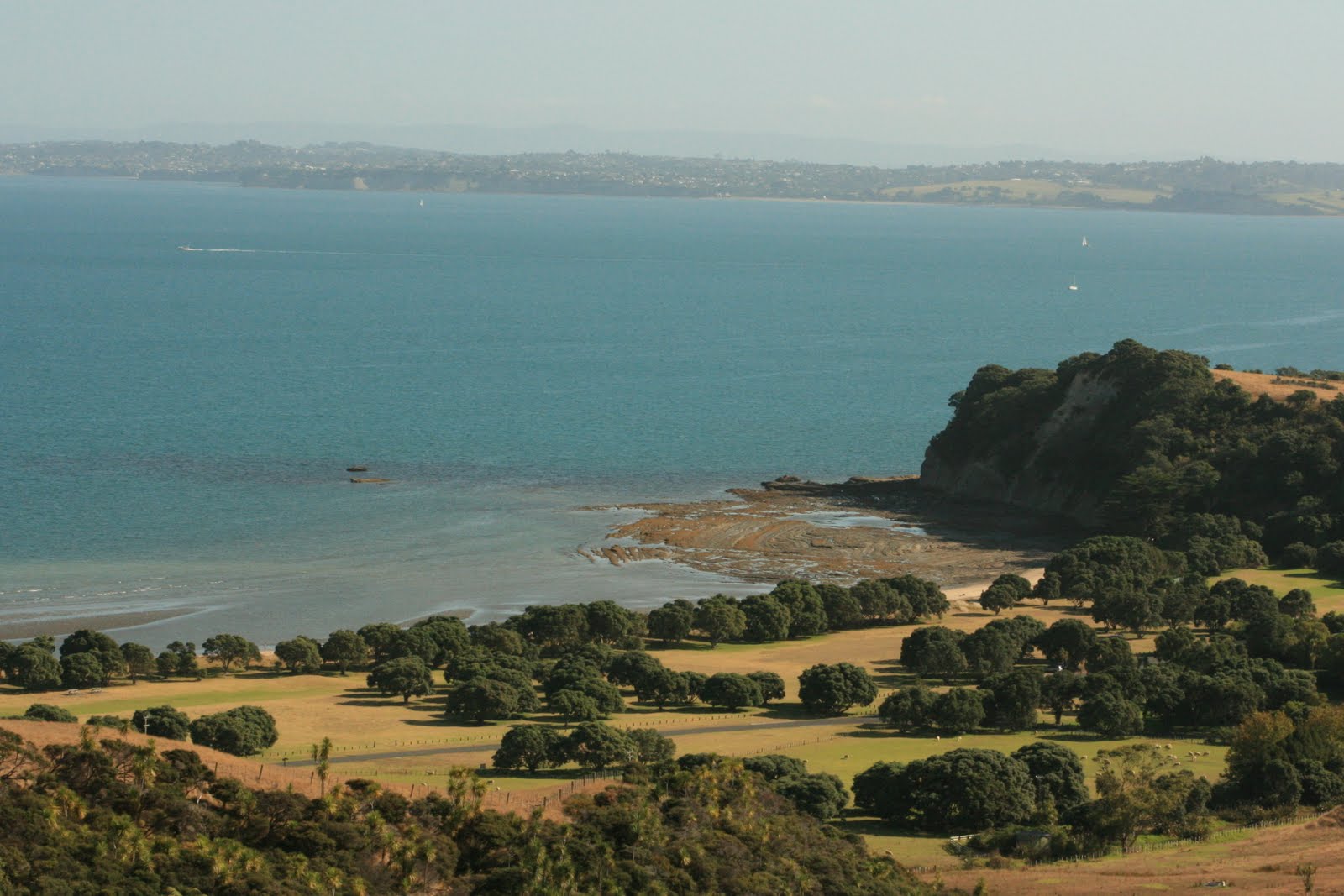 Views of Shakespear Bay
 The arrival of the Europeans was due to the Dutch seaman Abel Janszoon Tasman, who arrived to the Pacific after a long travel, on the 13 December 1642. Only five hundred years of convivence, democracy, and an adaptation that, as one can see, have not been enough to conformate a homogeneous society.
Since then, the controversy between Maoris and Europeans has not stopped. The Europeans continue to show its chauvinist way of life, just imposing “their” culture (British!) as the unique and true, and not accepting the beautiful differences of the world. The population, though, is conformed by a 30% of inhabitants in Auckland coming from Asia, from China and Japan mostly; and Pasifika, that is from the Cook Islands, Tahiti, Fidgi, Vanuatu, Tonga, Samoa, Papua New Guinea... there are thousand of islands in this part of the world.
Since then, the controversy between Maoris and Europeans has not stopped. The Europeans continue to show its chauvinist way of life, just imposing “their” culture (British!) as the unique and true, and not accepting the beautiful differences of the world. The population, though, is conformed by a 30% of inhabitants in Auckland coming from Asia, from China and Japan mostly; and Pasifika, that is from the Cook Islands, Tahiti, Fidgi, Vanuatu, Tonga, Samoa, Papua New Guinea... there are thousand of islands in this part of the world.

What is the result? A multicultural society which pretends to show the world that they are the most open-minded people in the world, with more than 30 nationalities in such a small population of 4 millions.
The reality, though, is another one: NZ has the highest rate of youth suicide in the world (I just have been given the task of teaching students with “special” needs, Emily Webster, whose brother died 4 weeks ago because of overdose of vodka) and Sammy Collins, whose ex-boyfriend commited suicide jumping from Newsmarket’s bridge 1 month ago, then his best friend (of the boy) jumped from his window two weeks later breaking some bones and last week a girl of the same group of friends tried to took her life by cutting her venes in the bathroom.
So, how do I have to treat this kids? I do not have any Degree in Psychology and actually, I am quite afraid of these tendencies. Emilie just broke into tears last week with no aparent reason, Sammy, who has the most horrible Spanish, explained to me that it is four months that she does not speak with his older brother.
One friend of mine of just told me once that this is the “island depressing syndrome”. I’m trying to understand. That’s true, Aotearoa is so far from every any other civilized country of the world (apart from Australia) that the young people find no escape. In Europe, you can change environment so easily... if you don’t like living in Spain you make a suitcase, take a plane and in an hour you are in Scottland, Germany or France, ready to begin a new life.
It is also true that mostly of the people would never do it, as they just accept the life they have in their countries and don’t have the need of exploring the world. But, at least, they do have the option to do it.
GOAT ISLAND & MAHURANGI REGIONAL PARK

Then, I begin to meet the different people and to analize why all this generalized closeness and depressive people.
The maoris, my favourite group, have strong values: the family, they continue to act as a clan, going together everywhere, defending their friends and people as the most important thing in the world.
The asiatic people, as far I can see, are “fashion addicts”. They wear last tendence clothes, but are really difficult people to adapt to the society, as they do not mix with other cultures.
The Europeans (immigrants from England, Ireland, Holland and Findland) are the worst ethnic group I ever met. First of all, they do not have history, no traditions, no typical food, in a word, no past. This defines so much this people!
I have the feeling the try to maintain an old fashioned Victorian society, consisting in having a very formal family, in which everybody is independent. In this family, the father works 12 hours a day, the mother does not cook, she has an au-pair taking care of the house, and do not care so much about the education of the children, as they pay the most expensive school in the city. In this context, the children are treated as adults, they don’t give them enough love and it results in making them egotistical, egocentrical, self fish.... they have to study 8 hours a day, play an instrument or two and be the Top-players in two different sports. They subject them to such a big pressure that when they arrive to adolescence, they are expected to be good in everything, if they fail, they are losers.
The maoris, my favourite group, have strong values: the family, they continue to act as a clan, going together everywhere, defending their friends and people as the most important thing in the world.
The asiatic people, as far I can see, are “fashion addicts”. They wear last tendence clothes, but are really difficult people to adapt to the society, as they do not mix with other cultures.
The Europeans (immigrants from England, Ireland, Holland and Findland) are the worst ethnic group I ever met. First of all, they do not have history, no traditions, no typical food, in a word, no past. This defines so much this people!
I have the feeling the try to maintain an old fashioned Victorian society, consisting in having a very formal family, in which everybody is independent. In this family, the father works 12 hours a day, the mother does not cook, she has an au-pair taking care of the house, and do not care so much about the education of the children, as they pay the most expensive school in the city. In this context, the children are treated as adults, they don’t give them enough love and it results in making them egotistical, egocentrical, self fish.... they have to study 8 hours a day, play an instrument or two and be the Top-players in two different sports. They subject them to such a big pressure that when they arrive to adolescence, they are expected to be good in everything, if they fail, they are losers.


Another figure that sends shivers down my spine is that 50% of the couple are divorced after the 3rd year... It is not strange that I give tuition to kids who live in the most beautiful of the houses three days a week with mum and the rest of the week with dad. Another practise very usual here is to send the children to the Boarding Houses of the schools. That is, they live in the school during the week and come back home for the weekend (but mostly of them remain in the Boarding house, as they do not get well with the father or preffer to stay in the city than going back home). Which values can have a child who is taught to be the best in everything, do not have a family to support him and never meet with his/her friends because they are allways busy with the Netball, Piano, Spanish tuition or any other private class?

So is my personal understanding of New Zealand society, which I do not share in anyway, as I do believe in the family, values, education but playing and a couple for all my life. So traditional am I.

And in the meantime, I will continue doing day trips in the most amazing lanscaped country...

And in the meantime, I will continue doing day trips in the most amazing lanscaped country...